Sunday, June 18, 2017

How to Identify a Narcissist

Do you know somebody who must ALWAYS be the center of attention?  And does this person try to "up-one" others in a conversation?  You might be head to head with a bonafide narcissist.
At first, a narcissist seems like they would be easy to spot.  Think about the jerk bragging or boasting in the break room or at the gym.  But, in reality, narcissists can be quite attractive with their charismatic and entertaining personalities.
By definition, a narcissist is a person who is excessively interested in themselves.  Here are a few tell-tale signs of a narcissist:
  • They need attention.  A narcissist is driven by positive attention from other people.  They want - even need - to be admired.  They relish flattery.  Their need for praise borders on addiction.  Oftentimes, a narcissist will adopt a new social circle in order to get their "fix" of praise and admiration.

  • They love the sound of their own voice.  A narcissist loves everything about themselves - even how they sound.  Conversations with a narcissist tend to very one-sided because they really don't care what is going on with you. Remember, it's all about them!

  • They are selfishness.  A narcissist is a self-centered and self-serving.  They do not see value in other people unless those others are serving the narcissist in some capacity. 

  • They are confident and flamboyant.  A narcissist will seek to stand out in a crowd and are absolutely sure that they are the most attractive person at any event.  They will often wear expensive, flashy, or provocative clothing to make sure everybody notices them.  

  • They don't apologize.  By now you may have gathered that narcissists do not think that they are wrong about anything.  Therefore, it goes without saying that a narcissist does not feel the need to apologize regardless of the obvious problems that they cause.  In fact, it isn't at all unusual for a narcissist to turn the entire situation around and make it somebody else's fault.

  • The hate to lose.  A narcissist is always up for a good competition, but they do not handle defeat well.

  • They hate to listen to others.  As mentioned, narcissists are totally blinded by their own ego.  Therefore, any conversation with another person will result in the narcissist turning the topic back around to their favorite topic - themselves.
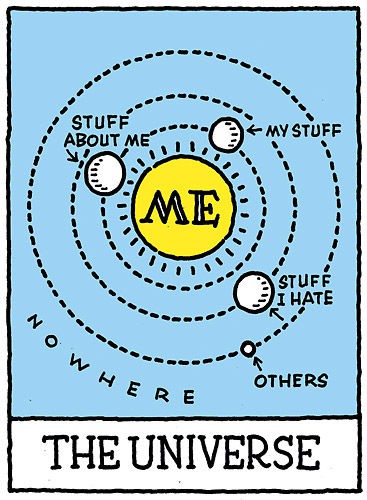
Now you have an idea of what a narcissist is how they behave.  Basically, a narcissist is somebody obsessed with themselves.  In their eyes, the universe makes a circle because of them and nothing else really matters.  At first, a narcissist may appear to be interesting and appealing - even sexy.  But the person dealing with a narcissist will soon discover otherwise.  A narcissist is only out to serve themselves.

Saturday, August 24, 2013

Pursuing Happiness on the Hedonic Treadmill


We all think we know what will make us happy. Maybe it's a new car, a new house, or a new body. And we find ourselves becoming absorbed in our obsession by studying advertisements, researching features, and admiring people who have already acquired said thing. Then one day you finally get it. You are ecstatically happy - at least for a little while. Why doesn't the happiness last?

The Components of Happiness
 
There are three main elements that contribute to happiness: pleasure, meaning, and engagement.
  • Pleasure is sensory enjoyments in life that tie into comfort and satisfaction. There are many sources of pleasure. For example, eating fine food, getting a massage, or listening to music could be fall under the category of pleasure. Pleasurable events alone, however, do not complete the happiness equation.
  • Meaning. People find meaning in their lives by being a part of and contributing to something bigger than themselves. Social activities such as joining a church, serving in a soup kitchen, or volunteering at a school are good examples of how people find fulfillment through meaningful interaction.
  • Engagement is accomplishing activities that involve challenges and require a person to use their skills and strengths. Usually engagement is seen in the context of doing something you are good at and that you enjoy like playing a sport, strumming a guitar, or writing essays. You know you are engaged when you in a state of "flow" and time seems to stand still.
These three factors together cause a person to achieve the subjective state that we call "happiness". The problem comes when we get stuck in the erroneous belief that instant gratification and materialistic pleasures are the only sources of happiness. Enter the hedonic treadmill……

The Hedonic Treadmill
 
Basically, the hedonic treadmill is a metaphorical reference to a theory based on the human tendency to focus on an object of desire, achieve that desire, experience brief happiness, and then change focus to another desire. You have probably experienced this cycle in your own life. As an example, say you want a new car. You believe that if you could obtain this car, your life would be changed. Instantly, you would feel great satisfaction and your life would be more complete. You locate the car of your dreams, save the required amount of money, and finally make the purchase. You are probably overjoyed with your new love and are likely to be very happy, indeed, as you proudly sport your new ride. But this state of bliss may last for a few months, at best. Eventually, your car will become just be a way to get from here to there - a lot like your old car. Sadly, you find that your life is no more complete than it was before you bought the car.

The theory behind the hedonic treadmill states that misdirected efforts to increase happiness generally fail. People usually return to their own particular "set-point" of happiness. In other words, few objects or events in life have the ability to significantly impact happiness on a long-term basis. The reason for this is that we, as humans, are hard-wired to continuously adapt to our circumstances.

"Stuff" Isn't the Answer
 
If materialism doesn't make a lot of difference in people's life, what does? In our consumer-driven society, there is a great amount of pressure to spend money on things. However, if you can find the courage to buck the system a little and go against the popular sway you may just end up being one of the truly fortunate ones that finds an extra measure of happiness. Try getting off of the hedonic treadmill by incorporating these fulfilling exercises instead:
  • Consciously do something nice for somebody else each day. It could be as simple as holding the door open for the person behind you.
  • Achieve "flow". Get lost in an activity. It could be a jigsaw puzzle, a sport, or a hobby. The goal is to activate your skills and engage them in a meaningful way.
  • Spend time reflecting. Identify the pleasurable portions of your day, but also acknowledge those events that give deeper significance and meaning to life.
There is more to lasting happiness than simply feeling good all of the time. Happiness depends largely upon intangibles like investing in quality relationships, contributing to the lives of others, and pursuing purpose through meaningful activities.

References:

Peterson, C., Park, N., & Seligman, M. E. (2005). Orientations to happiness and life satisfaction: The full life versus the empty life. Journal of Happiness Studies, 6, 25-41.

Seligman, Martin E. P. (2002), Authentic Happiness: Using the New Positive Psychology to Realize Your Potential for Lasting Fulfillment, New York: Free Press.

Saturday, August 10, 2013

Yoga for Stress Relief: Downward Facing Dog


In our society, many of us find ourselves completely stressed out on a daily basis.  It seems that most everybody is suffering from too many obligations, financial problems, relationship problems, or work-related stress.  To temporarily relieve some of the stress you might be carrying in your body, consider doing a few minutes of yoga each day.  This move in particular - downward facing dog - is an easy move to incorporate into your busy day.

How to do it

Downward facing dog is an easy pose that can be done almost anywhere.  All it really entails is getting into an inverted "V" position.  That being said, there are a few particulars for maintaining good form.
First off, start by getting on all fours.  Your knees should be under your hips and your hands should slightly in front of your shoulders.  Slowly raise your pelvis off the floor so that your body looks like a "V."  Try to keep your heels on the floor.  If you can't, don't worry about it.  With practice, your calf muscles will become more flexible and you will improve.  Your arms should be stretched out in front of your head and you should be looking at your feet.  Stay in this position for a minute or so, drop back to your knees to rest, then do it again.

In addition to relieving stress, this exercise will tone your upper body, increase the flexibility in your back, and give you a boost of energy.  Most people find that they feel better after about a week of practice.

Saturday, May 11, 2013

How to Relax More This Summer Without Going Away on Vacation

With the economy like it is, many people are not going to be able to afford to go on an exotic vacation this year.  But that doesn't mean that you can't get some rest and relaxation.  By changing just a few things - including your mindset - you can train yourself to go into vacation mode on a daily basis.

Summertime is marked by long, warm days which means it is the perfect time to use your evenings after work for a little R&R.  Here are some tips for learning how to vacation without taking off time from work or going very far away.

  • Unplug from high-tech.  When you get home in the evening, consider turning it all off.  Yes, that means phones, computers, iPads - everything.  Hgh-tech gadgets can cause high stress levels because they  keep us plugged in to our need to compulsively check stuff like e-mails, text messages, and our Facebook page. 

  • Change.  When you get home in the evening, the first thing you should do is change your clothes.  By changing into shorts, a swim suit, or lounging clothes you also give your brain the cue to change from work mode to vacation mode.  After you put on some comfortable clothes, change your location.  Don't stay in your living room and watch the news.  Why not take a drive to a local lake, river, or beach?  The long days of summer offer ample time for such excursions.

  • Think "staycation."    Just because you are not going anywhere far doesn't mean you can't have fun.  Take a day or two off from work and visit a spa, take the family to a water park or the zoo, or take your partner and spend the night in a fancy hotel on the other side of town.  These short one or two day trips can do a lot to rejuvenate and refresh.

Saturday, July 14, 2012

Happiness Resides Within


It seems that finding happiness and contentment seems to be a very difficult thing for people to do these days.  The Chinese philosopher, Lin Yu-tang, wrote:

The secret of contentment is knowing how to enjoy what you have, and to be able to lose all desire for things beyond your reach.

I think the key here is the first part of that sentence - enjoy what you have.  Why do we always want more? Is it our culture?  Is it conditioning?
 
Did you know that happiness, contentment, and joy are feelings that reside within every person already?  If you think for a moment, I’m sure that you can recall a time when happiness spontaneously bubbled up as you watched puppies play.  Maybe you experienced an overwhelming sense of contentment as you lay in your lover’s arms. Or think about the joy that sprang up inside of you when you graduated from college or welcomed your first child into the world.  Is happiness really something to pursue, or is it something that has been there all the time?  Maybe we should simply learn to take the blinders of desire off and turn our attention toward the treasure that is already yours.  Be happy with what you have.

Practice known secrets used by millionaires

Friday, March 9, 2012

Success is Not a Doorway, It's a Staircase

What is it that we all want? Isn’t it success and happiness? So, it’s no surprise that a reader in Iran is interested in success. Arash (not his real name) is a 35-year-old married carpenter who wants to become extremely successful. That is, he wants to be free from financial worries, free to travel anywhere, and free to do anything he and his family choose to do. To that end, he listens to Brian Tracy audio programs in his car and studies books on success. Arash is asking for help because he doesn’t know where and how to begin. He would like an action plan or roadmap to success that will end the confusion and clearly point out the steps he needs to follow. So, let’s begin.
Practice known secrets used by millionaires

The Staircase to Success

Step 1. The first step is to understand what is required for success. And what is that? Hard work! You've got to work harder than most people if you want to be more successful than them. To emphasize this point, let me quote William A. Ward (1921~1994), “The recipe of success is to study while others are sleeping, work while others are loafing, prepare while others are playing, and dream while others are wishing.” It is essential to realize that success is not a doorway that you walk through, but a staircase that requires effort to climb.

Step 2. After acknowledging that it will take hard work to succeed, you must be willing to make the effort and determined to do whatever it takes to succeed. In other words, you must be committed.

Step 3. You must understand that some difficult tasks are harder to do than others because of subconscious interference. Here’s an example of what I mean. Arash already has the self-discipline to exercise, but when it comes to taking steps for success, he feels powerless to act. Why is that? It is because when he tries ..............read more

Monday, February 13, 2012

Reasons You Can't Afford to Not Meditate


I used to have to deal with sub-clinical depression.  Even when my life was going really good, my emotional body would be laced with an underlying feeling of sadness and even utter hopelessness at times.  A few years ago, however, I started meditating and my world changed in some astounding ways.  I rarely ever deal with depression any more and I have learned to enjoy each life experience that comes along.

Somebody once likened meditation to the water that flows over rocks in a river.  The rocks are slowly smoothed and shaped by the continual running water.  Your life is a lot like those rocks that get transformed.  It happens slowly, but one day you wake up to find that your life has really changed.  Some of the jagged edges have been smoothed away and you are experiencing more peace. 

Here are a few reasons why your life should include daily meditation:

  • Meditation gives your brain a much-needed rest and allows for divine presence.  When we learn to manage the barrage of thoughts that clamor for our attention during the time of meditation, we are also learning how to listen to our deeper, wiser selves.  Through meditation, we can develop our intuition and hear directly from God.
  • Meditation returns us to center.  The nature of meditation itself involves the art of letting go.  And that includes practicing detaching from our charged emotions.  When we are engaging in emotional extremes, we are pulled into the past or catapulted into the future.  By letting go of those extremes in meditation, we can return to a more balanced state of being.
  • Meditation is good for your health.  By learning to become calm in meditation, you will automatically find yourself utilizing that skill when you are faced by the stresses of the day.  Research has shown that meditation lowers blood pressure, reduces the likelihood of having migraines, and reduces other stress-related symptoms.
Meditating is easy.  Sit in a relaxed position and close your eyes.  Become aware of and focus on your breathing without trying to control it.  When you can do this for about 5 minutes, then you can begin to repeat a spiritual mantra like God is love, or simply the word peace.
 

Tuesday, December 27, 2011

Making and Keeping New Year's Resolutions

New Year’s resolutions – does anybody keep them anymore?
The answer is “yes” if you know how to formulate them properly.  We all know people (maybe even you) who find that their ardently planned resolutions were dropped somewhere along the wayside right beside the motivation and enthusiasm that it took to create them.  So what is the secret to making resolutions and, more importantly, how do we keep them?
1.) Make sure that there is a true desire to change. Many people make resolutions based on the expectations of other people.  If you do not have a true desire to reach your goal, you most assuredly will not.
2.) Lay out your objectives with specificity. Many people make the mistake of stating their goals in very broad terms. Two very popular New Year’s resolutions are:  I want to quit smoking or, I want to lose weight.  These statements are not specific enough. Your subconscious mind plays a big role when it comes to reaching goals in life.  Taking that fact into consideration, say you are successful at losing one pound or one ounce. Your subconscious will perceive your goal of weight loss as having been reached and will stop helping you.  After all, you did lose weight.  To use your subconscious in the most effective manner, word your resolution statements in terms of measurable outcomes.  Consider these revised resolutions:  I am reducing my smoking and will smoke half as much by Valentine’s Day, or, I am making choices that result in a twenty pound weight loss by July of this year.
3.) Make your resolutions present tense. Keep in mind when making resolutions that the subconscious part of your brain operates in the present tense. Formulating your objectives in this manner will be much more powerful.  Here are some examples of effective resolutions: I am becoming healthier each day as I choose nutritious foods to eat, or, every day I am getting closer to becoming a non-smoker.  These types of statements are more readily accepted by your subconscious mind.
4.) Write your resolutions down. Experts agree that you increase the likelihood of reaching your goals significantly by just simply writing them down.  When you write your goals down, you develop a more visible target on which to focus and concentrate.  Your goals become clear objectives.
5.) Formulate smaller sub-goals.  The reason that many New Year’s resolution and other goals go unfulfilled is because they are too daunting.  That’s why breaking your goals down into smaller, more achievable chunks is a good idea.  If your goal is to lose twenty pounds then some smaller sub-goals would include things like, substituting fruit for sweets, eating raw vegetables for snacks during the day or setting a goal to walk for 30 minutes a day.  These are small yet very do-able actions that will lead to the greater goal of losing the amount of weight you want to lose.
Looking at resolutions in a new way and with new resolve involves having the right tools to implement a plan to achieve the results you desire. Let this be the year that you keep your New Year’s resolutions. 

Wednesday, December 21, 2011

Do You Know Where You are Going in LIfe?


"If you don't know where you are going, any road will take you there."
- Lewis Carroll, Alice in Wonderland

Would you be surprised to find out that most people do not set goals?  Except for giving brief attention to a failure-prone New Year's resolution list, most people don't give a second thought to what they want to accomplish this year, this month, or today.

Setting Yearly Goals

Having a target for the year sets your trajectory.  It points you in some general direction.  Let's say, for example, you decide you want to write a book this year.  This is a goal.  You have set an intention for the year.  Enter monthly goals.........
Practice known secrets used by millionaires
Setting Monthly Goals

Now that you have your yearly goal, you will need to set smaller monthly goals in order to accomplish your large one.  In the monthly breakdown of the book writing in the above example, you would set smaller achievements up month by month.  For example, you could intend to write one or two chapters a month.  Enter weekly and daily goals.............
Practice known secrets used by millionaires
Weekly and Daily Goals

This is where the work gets done.  In order to accomplish the monthly goals, your large project must be broken down further into smaller pockets of work.  For example, you would set aside a certain amount of time to write every day; or, you might schedule a weekly meeting with an editor or a writing coach to keep you on track.  You get the idea.

Any job, project, or undertaking can be accomplished when you break it down into smaller units.  Remember that big dreams are achieved ultimately through very small courses of action.

Monday, October 31, 2011

Put Down That Smartphone and Look at Me!

Hearing the inventory of Steve Jobs' ground-breaking innovations, it made me think of what effect his genius has had on how we now relate to each other.

What have we gained?

We can now make magic -- we can bolt right over those old time/space barriers that made connecting with each other take time and physical effort. Now we can communicate with each other instantly, effortlessly -- no seeing/hearing/touching/talking necessary. Our words fly through space and land just where we want them to with just the tap of a finger. And while we're with one person we can even answer another's demands and reach them too -- putting the live, visible person we're with on hold.

But what have we lost?

Communication science tells us that first impressions -- the input that helps us learn and discern as we judge people -- are made up of 55 percent experiencing your body language, 38 percent your tone of voice and that only 7 percent is your words. Seven percent of total information about anyone is what cell phones give us as we contact each other! Even less since......read more
Get Hired Learn Micorsoft Office & More $15.99/mo

Thursday, September 15, 2011

A Note From the Universe

From http://www.tut.com/ :

The secret behind miracles is that the one performing thembegins without any knowledge whatsoever of exactly how
they will succeed, yet still they begin.

When you move, I move -
The Universe

Wednesday, September 7, 2011

The Power of Imagination

“Imagination is everything. It is the preview of life's coming attractions.”
-Albert Einstein
Our imagination is the portal to creating our world.  Originating from simply thinking one thought and then another, imagination is our ticket to being, doing, and having the desires of our heart.  The key is to develop a belief in the power of thought.  After all, if thoughts are things that shape our world, then the work lies in controlling our minds and the thoughts that continually creep in and out.  This is the premise of positive thinking and positive affirmation.  Indeed, it is the basis for encouraging others in their endeavors, as well.  Psychologists have found that accentuating the positive is far more productive than emphasizing the negative.  Try this exercise in imagination:
·         See your life exactly as you would like it to be.
·         Describe how you feel when you have reached your goals.
·         Get into character by asking pertinent question like “who am I associating with?”, and “what do I look like now?”, or “how are things different?”
If you clearly see your life as you want it to be and continually view that mental film on a regular basis, you will see positive change come to your life.
Practice known secrets used by millionaires

Friday, June 3, 2011

The Secret of the Law of Attraction

The Law of AttractionThe law of attraction is a universal principle purporting that like attracts like. To expand this concept further, the law of attraction states that every physical circumstance starts with a thought. Thoughts attract other thoughts of similar nature that, in turn, give your subconscious mind focus and direction. This line of positive thinking causes people to notice opportunities and take advantage of situations that will cause conditions and events to manifest.

The Law of Attraction Begins with a Thought

Many people have expressed the law of attraction in axioms like, "be, do, have", or, "ask, believe, receive". These maxims serve to summarize the essence of the law of attraction. In addition, by coming up with a meaningful abbreviation, people can easily remember the steps for implementing this all-important universal principle.

To understand the law of attraction better, start by imagining that your thoughts have a magnetic quality. Positive thoughts attract good circumstances and negative thoughts, in turn, bring forth undesirable events and circumstances. The problem with the law of attraction has always been in choosing thoughts and keeping them positive, or at least keeping them headed in the right direction. If people will take a moment to stop and become aware of their thought patterns they will often find that much of their time is spent engaging in non-productive negativity. Since the law of attraction is always at work, life becomes a process of taking one step forward and one or more steps backward, resulting in little to no progress toward desired goals. It's this awareness that can revolutionize lives by empowering us to realize that as long as we are mentally sound, we are, in fact, in control of our own thoughts.

Defining What You Want in Life

Another problem with harnessing the power of the law of attraction is the fact that some people have a hard time really knowing what they want out of life. Consequently, they attempt to follow after vague aspirations instead of solid, tangible objectives. For example, if you want to manifest money, you need to be specific. Thinking, "I want a lot of money" is not a defined goal. Stating a precise amount sets tangible parameters around your objective. What about the person who says "I want to lose weight". This person's subconscious mind knows when they have lost two ounces, so to this portion of the mind, the goal has been met.

Your mind is a blank slate. Use your thoughts to write upon it only the things that you desire and you will find yourself living a life of success and happiness.

Tuesday, April 19, 2011

Mastering the Mind: A Perspective on Happiness and Success

Mastering the mind is a trait of successful people. They understand the workings of the mind's unlimited power. The trick is to focus on and learn to use the faculties of the conscious and subconscious. Joseph Murphy, Ph.D, in his wonderful book, "The Power of Your Subconscious Mind", compared the body to a large ship in the ocean with the captain and crew being the conscious and subconscious minds respectively. The captain - conscious mind - issues orders which are followed without question by the crew - subconscious mind.......read more

Monday, April 18, 2011

Overcoming Fear

Overcoming Fear

"Your imagination is your preview of life's coming attractions."
 --Albert Einstein

Fear is characterized by a feeling of uneasiness or apprehension that carries with it an intense emotional response to a threat either real or imagined. It is a painful emotion linked to the anticipation of impending doom, danger or dread.

Fear can be categorized into four distinct groups:

1) Fear of physical pain. This could be caused by an perceived aggressor but this type can also include the threat of starvation or lack of money to buy necessities to sustain you personally.

2) Fear of emotional and mental distress. An example of this would be the fear of losing a loved one either by breaking a relationship or by death.

3) Fear of physical pain suffered by others. A mother fearing injury to her child is a good example of this type of fear.

4) Fear of emotional and mental distress of others. For example, parents often feel an obligation to protect their children against others who might hurt their feelings.

The faceless demons of fear are ever present in many people’s lives, haunting their successes in the future and paralyzing them from any present efforts toward achievement. They are consistently warning themselves through negative self-talk about all that “might” happen. Does this sound like you? You are not alone. Millions of people suffer the effects of fear which often manifest as severe stress and anxiety.

How Fear is Learned

From early childhood, we develop patterns of fear in several different ways. We will discuss two of those ways here. ......read more

Sunday, March 13, 2011

A Guide to Lucid Dreaming

Many people report being able to achieve lucidity in their dreams without even trying, even though for the vast majority of people, this skill must be learned with practice. The good news is that studies show that most people have the propensity to learn to have lucid dreams.

Lucid Dreaming

Lucid dreaming is when the dreamer becomes aware that he or she is dreaming while remaining physically asleep. Lucid dreaming can be achieved at varying levels. At the lowest level, the dreamer may be aware that they are dreaming but may not be fully aware that they can control the events and characters in the dream. With higher levels of lucidity, however, dreamers become fully cognizant that the dreamscape can be altered and controlled. People who are lucid while dreaming often report purposely having exhilarating experiences, like flying, that are only to be had in dreams.

Why Develop Lucid Dreaming Skills?

As people first learn that there is such a thing as becoming lucid in dreams, they often wonder why learning to have this type of dream would be desirable. The answer for most people is that when you become aware that you are dreaming, your dreams can take on an added dimension that is only limited by the imagination. Lucid dreamers can concoct their own adventure and excitement by traveling to other planets or conversing with loved ones that have passed.

Lucid Dreams as Therapy

Also documented is the therapeutic value that lucid dreams can have.

• People who regularly suffer with bad dreams or nightmares can use lucidity in dreams as a means of confronting the scary elements of the dreams that haunt them.

• Many people use lucid dreaming to rehearse awkward or fearful situation. For example, motivational speakers use dreams to rehearse their public speaking engagements. Sports enthusiasts, also, have been known to use lucid dreaming to enhance their competitive edge.

• People in creative arts professions like artists, writers, photographers and musicians, also regularly use lucid dreams to inspire creativity. The dreamscape can provide these artists a custom studio where they are free to create in ways impossible in the real world.

Steps to Having Lucid Dreams

The three basic steps to lucidity are dream recall, questioning your conscious state, and learning to identify personal dream signs.

• The first step is to develop the ability to recall your dreams. The reason is obvious. If you cannot remember your dreams, you will not know if you have achieved lucidity. Training yourself to remember dreams is simple although it may take some time. Simply intend to remember your dreams as you fall asleep. Record whatever you remember in the morning, even if it just a feeling or a sensation. Eventually, you will retain more and more content from your dreams.

• Learn to question your conscious state while awake. Much of what constitutes dream material is the residue of habits formed in waking life. As silly as it sounds, developing the habit of asking yourself if you are dreaming while you are awake will increase the likelihood of you asking the same question while you are actually dreaming.

• As you examine your dream journal, you will notice common themes. These are called dream signs. These signs will signal the dreamer that they are dreaming and will act as signals which make it easier to reach the lucid state.

Defining lucidity involves simply realizing that you are having a dream. Lucid dreamers report wonderful experiences and most people desire to achieve lucidity. Besides adding excitement and adventure, lucidity can be a therapeutic way to stop nightmares, inspire greater levels of creativity and otherwise help people with everyday challenges.

Sunday, February 13, 2011

Aging with an Attitude

I am immensely inspired by what Pearl S. Buck, the author of The Good Earth fame and Nobel prize winner, had to say on her 80th birthday. It was published in the Modern Maturity magazine but I came across it through Earl Nightingale's Motivational Moments.

Many people are conditioned to think that after 65, one should sit down, relax and watch the rest of the world with amusement and pity as it goes through the motions of detestable jobs, demanding child-rearing and dreary household chores. Buck impresses me with her task-centeredness. She writes this note sitting at her worktable facing the window and saying, "I have much work to do and I enjoy myself and what I do."

As people advance into the senior years, many must deal with the loss of their spouses, friends and relatives and, yes, look in the eyes of that scary monster loneliness. After the death of a spouse, or seeing children or grandchildren move away, loneliness sometimes.....read more

Friday, February 4, 2011

Straightforward Inspiration for the Business Minded Person

Currently, I’m reading a new book about how selling is a part of every aspect of your life. I’ve read about this concept before, but reading it again written with new insights is a really good way to spend your time. It helps to refresh what you’ve already learned, and ingrain the fundamental aspects of success in your mind.......

read more

Friday, January 28, 2011

The Perils of Being Too Goal Focused

If you read many books or websites about self improvement in general, and success in particular, you will notice one theme, one concept, that appears more often than nearly any other: setting goals. I even recommend it myself, from time to time.

Setting goals can help you to focus your energy and effort, making it far more likely that you will get something accomplished. That, in general, is
............read more